Dev C++ Basic Syntax
To understand basic syntax of any C++ program. Let's look at this basic and general form of a simple C++ program.
This is the basic syntax of a simple C++ program. In the above code fragment, the function, clrscr() is used to clear the output screen. Whereas the function getch() holds the output screen until user press a key.
Semicolons in C++
1 Introduction to the IDE. Dev-C is a full-featured Integrated Development Environment (IDE) for the C/C programming language. As similar IDEs, it offers to the programmer a simple and unified tool to edit, compile, link, and debug programs. C Basic Syntax In the previous article you wrote your first C program. But if you want to write more C programs then you will need to learn the syntax of C Programming Language. C Basic Syntax In the previous post, you learned to create simple Hello World program in C by using Notepad or Dev-C editor. This tutorial teaches you the basic syntax of C programming language that you should know since you are new to this computer programming language.
Semicolons in C++ are used to terminate statements. Here is an example of semicolons in C++:
Block in C++
A block in C++, basically is a set of logically connected statements inside opening and closing braces. Here is an example:
Whitespace in C++
Whitespaces may be blanks, newlines, tabs, etc. Here is an example. Here there is a whitespace between the type int and variable age:
Now let's take some example programs from simple to function program to understand the basic syntax of a simple C++ program. Here we have provided 7 type of C++ programs for understanding the basic syntax of these programs. Let's start with simplest C++ program, which will print 'Hello, World' on the output screen.
Here is the sample output of this C++ program:
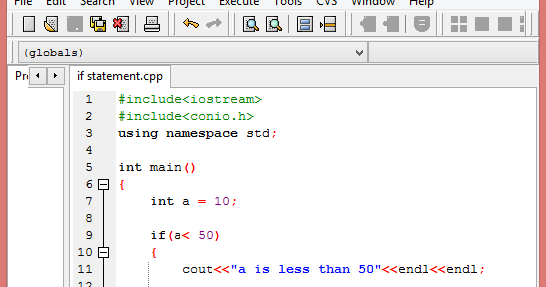
Here is another type of C++ program, uses if statement:
Here is the sample run of the above C++ program:
Here is one more type of C++ program, uses if-else statement:
Below are the two sample run of the above C++ program:

Let's take another type of C++ program, uses for loop:
Below is the sample output of this C++ program:
Here is another type of C++ program, uses while loop
Below is the sample output of the above C++ program. This output is same as the above one.
Below is another type of C++ program, uses do-while loop:
Here is the sample output of the above C++ program. This C++ program also produces the same output as the above two C++ program produced.
Let's take one more type of C++ program, uses function.
Below is the sample run of the above C++ program:
More Examples
Here are some more C++ programs listed, that you can go for:
-->
Developer Command Prompt for Visual Studio enables you to use .NET Framework tools more easily. It's a command prompt that automatically sets specific environment variables. After opening Developer Command Prompt, you can enter the commands for .NET Framework tools such as ildasm or clrver.
Prerequisites
Search for the command prompt on your machine
You may have multiple command prompts, depending on the version of Visual Studio and any additional SDKs and workloads you've installed. If the following steps don't work, you can try to manually locate the files on your machine or start the command prompt from inside Visual Studio.
Windows 10
Select Start and scroll to the letter V.
Expand the Visual Studio 2019 folder.
Choose Developer Command Prompt for VS 2019 (or the command prompt you want to use).
Alternatively, you can start typing the name of the command prompt in the search box on the taskbar, and choose the result you want as the result list starts to display the search matches.
Windows 8.1
Go to the Start screen, by pressing the Windows logo key on your keyboard for example.
On the Start screen, press Ctrl+Tab to open the Apps list, and then press V. This brings up a list that includes all installed Visual Studio command prompts.
Choose Developer Command Prompt for VS 2019 (or the command prompt you want to use).
Windows 7
Choose Start and then expand All Programs.
Choose Visual Studio 2019 > Visual Studio Tools > Developer Command Prompt for VS 2019, or the command prompt you want to use.
If you have other SDKs installed, such as the Windows 10 SDK or previous versions, you may see additional command prompts. Check the documentation for the individual tools to determine which version of the command prompt you should use.
Manually locate the files on your machine
Dev C++ Basic Syntax Example
Usually, the shortcuts for the command prompts you have installed are placed at the Start Menu folder for Visual Studio, such as in %ProgramData%MicrosoftWindowsStart MenuProgramsVisual Studio 2019Visual Studio Tools. But if, for some reason, searching for the command prompt doesn't produce the expected results, you can try to manually locate the shortcut on your machine. Try searching for the name of the command prompt file, such as VsDevCmd.bat, or go to the Tools folder, such as %ProgramFiles(x86)%Microsoft Visual Studio2019CommunityCommon7Tools (path changes according to your Visual Studio version, edition, and installation location).
Start the command prompt from inside Visual Studio
Dev C Basic Syntax In Word
For easier access, you can add Developer Command Prompt, or any other command prompt, to the Tools menu in Visual Studio. To make the tool available, add it to the external tools list. Here are the steps:
Open Visual Studio.
On the start window, choose Continue without code.
On the menu bar, choose Tools > External Tools.
On the External Tools dialog box, choose the Add button. How to cook everything vegetarian free pdf download. A new entry appears.
Enter a Title for your new menu item such as
Command Prompt.In the Command field, specify the file you want to launch, such as
%comspec%orC:WindowsSystem32cmd.exe.In the Arguments field, specify where to find the specific command prompt you want to use, such as
/k 'C:Program Files (x86)Microsoft Visual Studio2019CommunityCommon7ToolsVsDevCmd.bat'. This command launches the Developer Command Prompt that's installed with Visual Studio 2019 Community. Change this value according to your Visual Studio version, edition, and installation location.In the Initial directory field, specify the directory in which the command prompt will start. Choose a value such as Project Directory by selecting the arrow next to the field.
Choose the OK button.
The new menu item is added, and you can access the command prompt from the Tools menu.